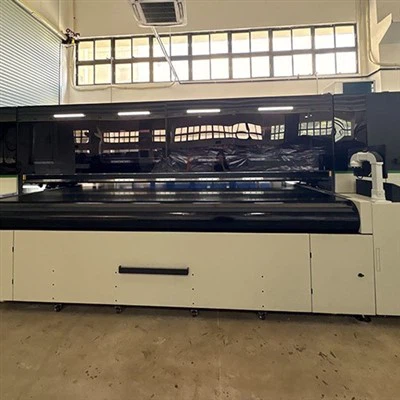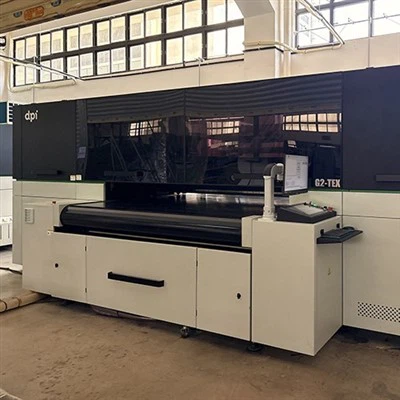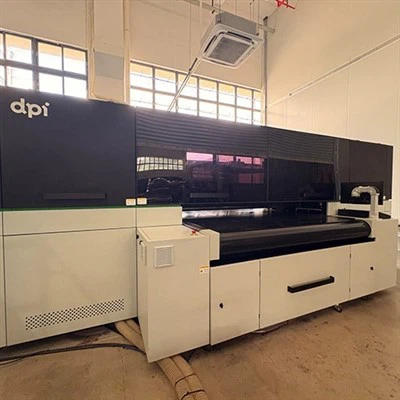


In today's digital age, where the digital wave is reshaping manufacturing, scanning digital inkjet printers, with their unique technological advantages and wide applicability, have become one of the core pieces of equipment for the printing industry's transformation towards intelligence and personalization. As a cutting-edge device integrating precision mechanical control and digital image processing, it achieves efficient conversion from design drafts to finished products through a line-by-line scanning dynamic printing mode, opening a new chapter of high flexibility and low loss for industrial printing.
The core principle of scanning digital inkjet printers lies in "dynamic imaging + precise jetting." The equipment is equipped with a high-precision guide rail system and servo drive device. The printhead moves at a uniform speed along the width of the media, and, in conjunction with the line-by-line resolution of digital image signals, precisely projects micron-sized ink droplets onto the surface of the substrate. Unlike the fixed width limitations of traditional fixed array printing, the scanning structure breaks through physical boundaries, allowing for the coverage of media of any length through single or multiple scans, making it particularly suitable for large-format and non-standard size processing needs. Meanwhile, the combination of multi-color independent printheads working together with variable droplet technology (such as grayscale printing) results in smoother color transitions and significantly improved tonal expression. This satisfies both the clarity and weather resistance required for industrial markings and the delicate texture of artistic printing.
In terms of technical characteristics, scanning digital inkjet printers exhibit three major advantages. First, they offer exceptional flexibility. Eliminating the need for plate making and changing processes, they support small-batch customization and multi-variety switching, perfectly aligning with the current market trend of "multiple varieties, small batches," effectively reducing inventory pressure and trial-and-error costs. Second, they balance precision and efficiency. Relying on an advanced motion control system and real-time error compensation algorithm, printhead positioning accuracy reaches ±0.01mm, coupled with high-speed scanning capabilities (linear speeds exceeding 2 meters per second on some models), ensuring detail reproduction while increasing production capacity. Third, they offer broad material compatibility. From paper and plastic film to metal foil and glass, stable adhesion can be achieved by adjusting ink formulations and process parameters, expanding the application scenarios of printing in packaging, building materials, electronics, and other fields.
Currently, with increasingly stringent environmental policies and a deepening of green manufacturing concepts, scanning digital inkjet printers, employing on-demand inkjet technology (ejecting only the required ink droplets), reduce ink waste by approximately 30%-50% compared to traditional printing. Furthermore, most models support environmentally friendly ink systems such as water-based and UV-cured inks, further aligning with the demands of sustainable development. In the future, with improved printhead resolution, the widespread adoption of intelligent calibration systems, and deep integration with the Industrial Internet, this technology is expected to unleash greater potential in fields such as precision manufacturing and cultural creativity, continuously driving the printing industry towards "intelligent manufacturing + quality manufacturing."