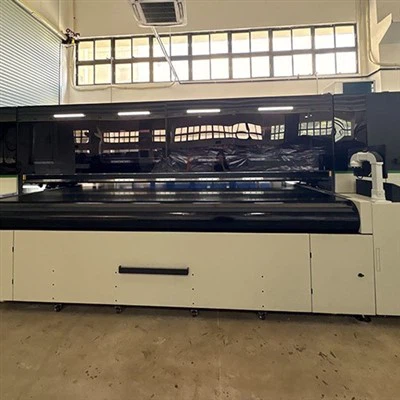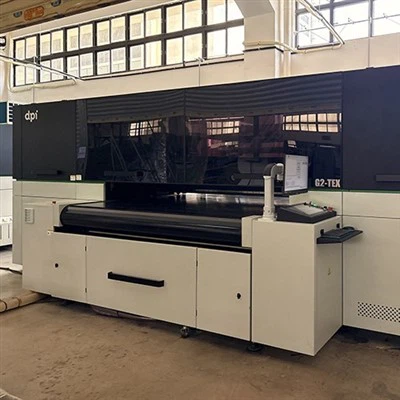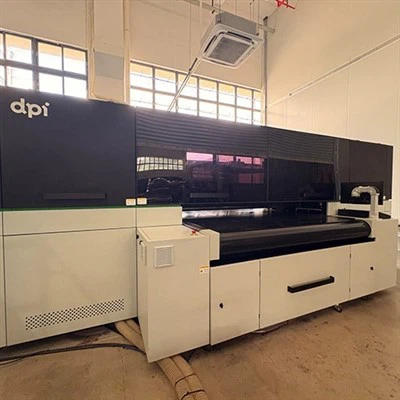


Against the backdrop of deep integration of digitalization and intelligent manufacturing, scanning digital inkjet printers, as key equipment in the printing field, are ushering in a new wave of technological and application upgrades. These industry trends not only reflect the manufacturing industry's urgent need for flexible production, personalized customization, and green environmental protection, but also foreshadow a profound reshaping of the printing industry landscape.
Firstly, continuous improvement in precision and resolution has become a significant trend. With advancements in printhead manufacturing processes, micro-droplet control capabilities have been continuously enhanced, and droplet diameters can now be as small as several picolinars. Combined with more precise guide rails and servo systems, scanning equipment can maintain sub-pixel-level positioning accuracy even in large-format processing. This not only meets the demands of high-end packaging and electronic circuit printing, which require extreme attention to detail, but also makes the reproduction of gradient colors and complex graphics more realistic, propelling printed materials from "usable" to "artistic."
Secondly, the level of intelligence and automation is rapidly increasing. New-generation equipment commonly incorporates industrial IoT interfaces, enabling remote monitoring, fault warnings, and parameter self-optimization. By integrating machine vision and artificial intelligence algorithms, the equipment can detect printhead status, droplet distribution, and media deformation in real time during operation, and automatically correct the printing path and color output, significantly reducing the frequency of human intervention and improving production line continuity and stability. This "perception-decision-execution" closed loop is upgrading scanning digital inkjet printers from stand-alone tools to intelligent production nodes.
The horizontal expansion of application areas is also noteworthy. In addition to traditional advertising, packaging, and textile printing, the equipment's penetration rate is continuously increasing in emerging markets such as building materials decoration, functional printing, and 3C electronic labeling. For example, in the personalized pattern printing of architectural ceramics and glass curtain walls, scanning inkjet printers, with their ability to adapt to large formats and non-standard sizes, can efficiently achieve integrated presentation of complex textures and colors; in the printing of small labels and anti-counterfeiting codes for electronic products, their high precision and material compatibility also demonstrate unique advantages.
Green sustainability has become an industry consensus. Scanning digital inkjet printers use on-demand inkjet technology, which can effectively reduce ink waste. Combined with the application of water-based, UV-cured, and bio-based ink systems, it significantly reduces VOC emissions and energy consumption. Driven by increasingly stringent environmental regulations and carbon reduction targets, more companies are integrating clean production and circular economy concepts into their equipment R&D and application processes, propelling the industry towards a low-carbon transformation.
Looking ahead, with iterative printhead technology, improved intelligent control systems, and deep integration with big data platforms, scanning digital inkjet printers will play a more central role in flexible manufacturing, cultural and creative industries, and high-end industrial support, continuously leading the printing industry towards a new stage of high-quality, high-efficiency, and sustainable development.