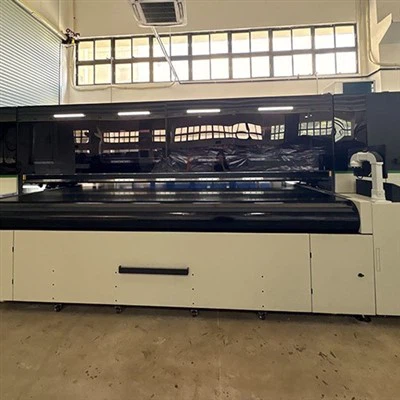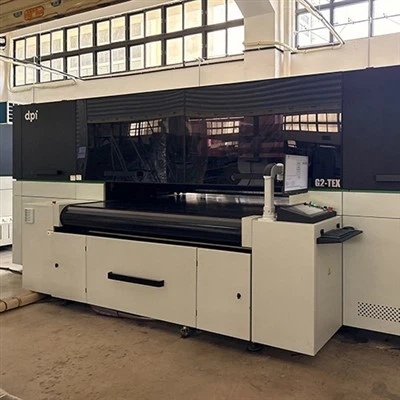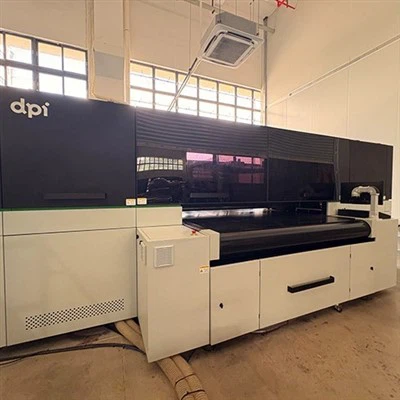


In the process of accelerating the digital and intelligent transformation of the manufacturing industry, scanning digital inkjet printers, with their unique technical architecture and diverse application value, are gradually becoming a key driving force for the upgrading of the printing industry.As a composite equipment integrating precision mechanics, digital control, and microfluidic technology, it not only reconstructs the production logic of traditional printing but also demonstrates irreplaceable strategic significance in flexible manufacturing, green production, and cross-domain integration.
The core competitiveness of scanning digital inkjet printers stems from their technical characteristics of "dynamic scanning + precise printing." Unlike the physical width limitations of fixed array printing, it uses high-precision guide rails to drive the printhead to move at a uniform speed along the width of the medium, combined with line-by-line resolution of digital image signals, to achieve continuous imaging of media of any length and width. This design breaks through the constraints of large-scale production in traditional printing, transforming small-batch customization and multi-variety switching from a "high-cost problem" into a "normalized demand," especially aligning with the current trend of personalized and fragmented consumer market development. Meanwhile, the combination of multi-color independent printheads working together with variable droplet technology allows for smoother color transitions and more precise detail reproduction. This not only meets the weather resistance requirements of industrial marking but also achieves the textural expression of artistic printing, expanding the application boundaries of printing in packaging, building materials, electronics, and other fields.
In industrial practice, the value of scanning digital inkjet printers has permeated multiple dimensions. In terms of production efficiency, its "plate-free, on-demand printing" model eliminates the plate-making and plate-changing processes of traditional printing, shortening order delivery cycles by more than 50% and significantly reducing inventory pressure and trial-and-error costs. In terms of quality control, relying on real-time error compensation algorithms and closed-loop control systems, printhead positioning accuracy can reach ±0.01mm level. Combined with high-speed scanning capabilities (linear speeds exceeding 2 meters per second for some models), it increases throughput per unit time while ensuring detail accuracy. In terms of sustainable development, on-demand inkjet technology reduces ink waste by 30%-50% compared to traditional printing. Furthermore, its compatibility with environmentally friendly ink systems such as water-based and UV-cured inks allows it to effectively respond to the green manufacturing requirements under the "dual carbon" goal.
Currently, with the deep integration of the Industrial Internet, artificial intelligence, and printing technology, scanning digital inkjet printers are evolving from "single production tools" to "intelligent production nodes." By embedding IoT sensing modules and data analysis systems, the equipment can achieve real-time monitoring of operating status, fault warnings, and parameter self-optimization. It can even link with upstream design software and downstream sorting systems to build flexible and intelligent printing production lines. In the future, with further improvements in printhead resolution and continuous expansion of material compatibility, its application in high-end fields such as precision manufacturing and cultural creativity will become more in-depth, continuously driving the printing industry towards a high-quality development stage of "intelligent manufacturing + quality manufacturing."