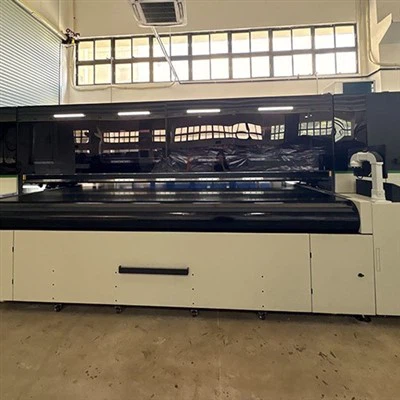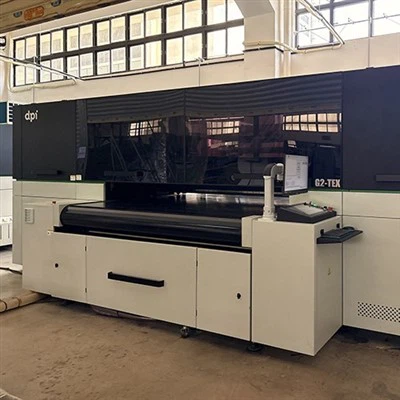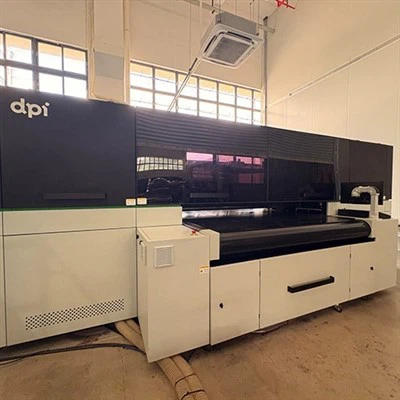


In the process of ceramic manufacturing transitioning from experience-driven to data-driven approaches, digital glazing machines, as a new type of equipment integrating sensing technology, automatic control, and materials science, hold scientific significance not only in improving process efficiency but also in constructing a precise, quantifiable, and intelligent research system for ceramic surface decoration. This provides a typical example for the cross-integration of materials science, manufacturing science, and information science.
From a materials science perspective, digital glazing machines overcome the bottleneck of traditional glazing's reliance on experience. Traditional glazing relies on manual control of glaze concentration, glazing pressure, and spray speed. Glaze thickness and uniformity are significantly affected by the operator's experience, easily leading to defects such as color difference and pinholes. Digital equipment, through high-precision flow sensors, pressure feedback systems, and closed-loop control algorithms, can monitor glaze viscosity, flow rate, and nozzle posture in real time, controlling glaze thickness fluctuations to the micrometer level, making the interface reaction between the glaze and the ceramic body more controllable. This precise control provides stable experimental conditions for studying the quantitative relationship between glaze formulation, particle size distribution, and firing performance, propelling glaze science from "trial and error optimization" to "model prediction."
At the manufacturing science level, digital glazing machines have driven research into the "digital twin" of ceramic surface treatment. The multi-source data acquisition system (such as high-speed photography, infrared thermography, and laser thickness measurement) on the equipment can simultaneously record dynamic parameters of the glazing process, and, combined with numerical simulation technology, construct a correlation model of "process parameters-glaze morphology-final performance." This model can not only optimize existing processes but also predict the glazing behavior of new materials (such as nano-glazes and functional glazes), providing theoretical support for the development of new processes. For example, by simulating the atomization effect of glaze slurries with different viscosities, the design of nozzle structure and atomization pressure can be guided, improving the uniformity of glaze layers on complex curved surfaces.
From the perspective of interdisciplinary information science, digital glazing machines are the practical application of the Industrial Internet of Things (IIoT) and Artificial Intelligence (AI) in the ceramics field. Its built-in intelligent algorithm can autonomously learn the optimal glazing parameters for different body materials and glaze properties, achieving adaptive process adjustments. The introduction of an edge computing module further enables the equipment to perform real-time fault diagnosis and process correction. This closed-loop system of "perception-decision-execution" provides a key technology verification platform for intelligent research in discrete manufacturing, validating the applicability of data-driven manufacturing models in the traditional ceramics industry.
Furthermore, the scientific significance of the digital glazing machine is also reflected in sustainability research. By precisely controlling the amount of glaze slurry used and recovering unattached glaze, the equipment can significantly reduce raw material waste and wastewater discharge, providing an empirical case for low-carbon process research in the ceramics industry and contributing to theoretical innovation in material preparation under the "dual carbon" goal.
In summary, the digital glazing machine is not only an innovation in process equipment but also a hub for multidisciplinary research. Its scientific significance lies in elevating ceramic surface treatment from a "technique" to a "science," providing a quantifiable and reproducible research paradigm for material design, manufacturing optimization, and intelligent production, propelling ceramic science into a new stage of precise control and intelligent innovation.