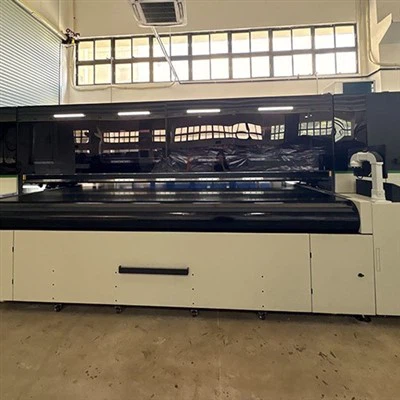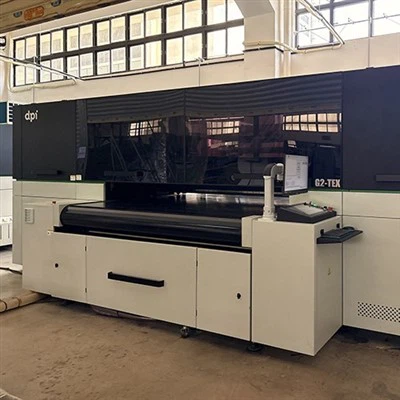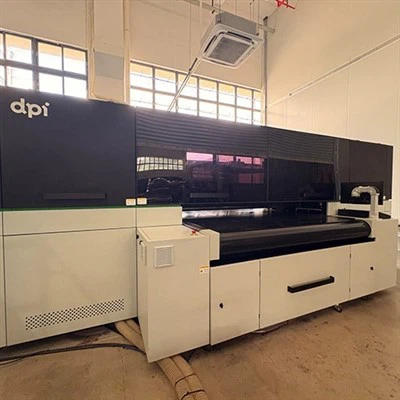


As the ceramic manufacturing industry accelerates its move towards refinement, personalization, and intelligence, ceramic inkjet printers, as core digital equipment, are profoundly changing the production model and artistic expression boundaries of traditional decorative crafts.By directly converting digital graphics into micron-level ink droplets, they achieve high-precision, high-fidelity pattern rendering on ceramic tiles, sanitary ware, and everyday ceramics, becoming a key technological support for driving the ceramic industry's leap from "mass production" to "creative intelligent manufacturing."
The essence of ceramic inkjet printing is the seamless conversion of "digital pattern-physical image." The equipment relies on a computer-aided design system and a high-precision printhead array to decompose vector or bitmap data into printhead-recognizable jetting commands. Through piezoelectric or thermal foaming technology, specially formulated ceramic ink is precisely jetted in picolinar droplets onto the glaze or body surface. Unlike traditional screen printing, which requires cumbersome processes like plate making, ink preparation, and color matching, digital inkjet printing achieves instant "design-to-production" response. Small-batch customization or multi-color switching requires no downtime for adjustments, significantly reducing the cycle from concept to finished product. This is particularly suitable for the needs of personalized home furnishings, artistic tiles, and niche design markets.
In terms of technical characteristics, ceramic inkjet printers exhibit three core advantages. First, they break through traditional limitations in pattern precision and color performance. Mainstream models have printhead resolutions exceeding 1200 dpi, with the smallest droplet diameter only a few picometers, accurately reproducing gradient transitions, macro textures, and complex light and shadow effects. Color saturation and reproduction are improved by more than 30% compared to screen printing, even capable of replicating the delicate textures of oil paintings and photographs. Second, their material adaptability and process compatibility are significantly enhanced. The equipment supports printing on various media, including glazes, blanks, dry granules, and adhesives. Combined with specialized ceramic inks (such as underglaze, in-glaze, and transparent glaze), it can achieve uniform coloring on flat, textured, and irregularly shaped surfaces, expanding the application scenarios for special decorative effects such as relief, antique finishes, and metallic sheen. Thirdly, it boasts significant advantages in production efficiency and cost control. On-demand inkjet technology achieves ink utilization rates exceeding 90%, reducing pigment waste by more than 40% compared to traditional printing. The plateless printing mode eliminates plate making and cleaning processes, reducing labor and time costs by approximately 50%, offering significant economic advantages, especially for small-batch, multi-batch orders.
Environmental friendliness is another major highlight of ceramic inkjet printing. Traditional screen printing faces strict environmental regulations due to the large use of organic solvents, pigments, and cleaning wastewater; while digital inkjet printing uses water-based or low-VOC ceramic inks, emitting no harmful gases, and cleaning wastewater can be recycled. Energy consumption and pollution emissions per unit product are reduced by more than 60% compared to traditional processes, aligning with the global trend of green transformation in manufacturing.
Currently, with extended printhead lifespan, reduced ink costs, and the maturity of intelligent color calibration technology, ceramic inkjet printers have evolved from "auxiliary equipment" to a mainstream choice for large-scale production, widely used in architectural ceramics, sanitary ware, and art decorative ceramics. In the future, with the integration of AI pattern generation, 3D stereoscopic printing, and multi-material composite printing technologies, they will further unleash the creative potential of ceramic decoration, injecting stronger digital momentum into the industry.