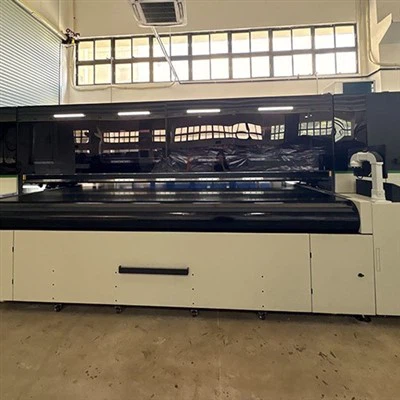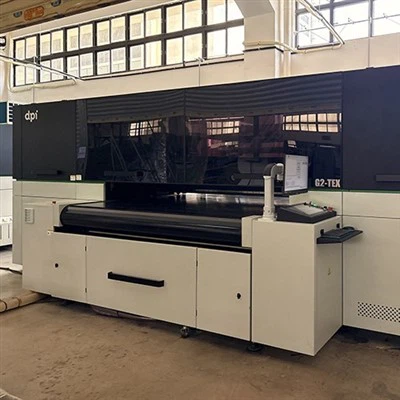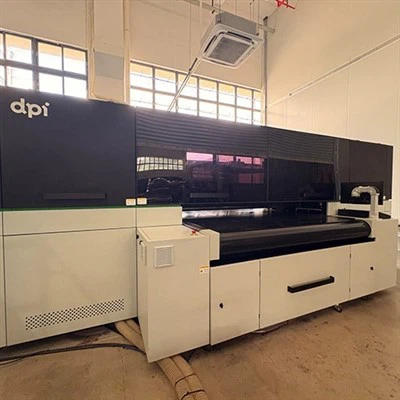


Against the backdrop of the ceramic industry's accelerated development towards personalization, refinement, and intelligence, ceramic inkjet printers, with their comprehensive advantages of high precision, high flexibility, and environmental friendliness, have expanded their applications beyond traditional decoration boundaries, deeply penetrating multiple fields such as architectural ceramics, sanitary ware, art decoration, and specialty ceramics. They have become core equipment driving creative production and improving efficiency within the industry.
In the architectural ceramics sector, inkjet printers are most widely used. Whether it's interior or exterior wall and floor tiles, antique tiles, or slabs, the equipment can directly display digital patterns on the glaze or body, achieving realistic reproductions of stone textures, wood grain patterns, abstract art, and even photographic works. Its high-resolution output and delicate gradation capabilities ensure that large-format slabs maintain visual continuity after installation, meeting the decoration needs of high-end residences, commercial spaces, and public buildings. Furthermore, with the help of a multi-channel ink system, different textures such as matte, glossy, and metallic sheen can be superimposed on the same tile surface, expanding the design's layers and expressiveness.
Sanitary ware ceramics are another important application area. Bathroom vanity panels, washbasins, bathtubs, and shower enclosures often require waterproofing, wear resistance, and aesthetic appeal. Ceramic inkjet printers can precisely print patterns, geometric designs, or custom logos on glazes or special coatings, achieving excellent colorfastness and stain resistance through high-temperature sintering. This preserves artistic beauty while meeting the stringent durability requirements of the bathroom environment. For irregularly shaped curved parts, using multi-axis linkage printheads or rotating platforms can also achieve uniform coloring, solving the problem of complex shapes that traditional printing struggles to cover.
In the realm of art and decorative ceramics, inkjet printing technology grants creators unprecedented freedom. Sculptures, vases, ornaments, and customized gift ceramics can showcase the artistic spirit of paintings, calligraphy, or photographs through highly accurate patterns, even achieving multi-media composite decoration, such as applying carving or glazing techniques after printing on the ceramic body, creating a fusion of three-dimensional and two-dimensional effects. Such applications have significant advantages in high-end customization, cultural IP collaborations, and collectible ceramics.
Inkjet printing solutions are also beginning to be introduced into the field of specialty ceramics. For example, in the production of electronic ceramic substrates, new energy battery separators, or high-temperature resistant components, the equipment can print functional patterns, such as conductive lines, heat-insulating textures, or identification codes, using specific slurry systems, thus combining decorative and functional integration. Although this application has special requirements for ink formulation and curing processes, the non-contact and programmable nature of inkjet printing provides a feasible path for such precision processing.
Furthermore, ceramic inkjet printers also play a role in cultural and creative products, educational training, and sample prototyping. Their rapid plate changeover and single-piece printing capabilities allow designers and manufacturers to validate creative solutions quickly, shorten development cycles, reduce trial-and-error costs, and thus accelerate the time to market for new products.
Overall, the application scope of ceramic inkjet printers has expanded from simple planar decoration to diverse scenarios such as three-dimensional molding, functional integration, and cultural and creative industries. Their cross-domain adaptability and continuously evolving technological capabilities are constantly broadening the possibilities of ceramic decoration, injecting lasting momentum into industrial innovation and value enhancement.