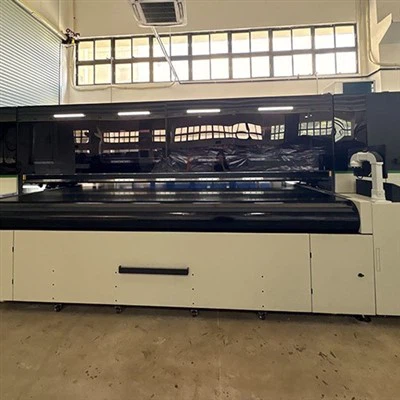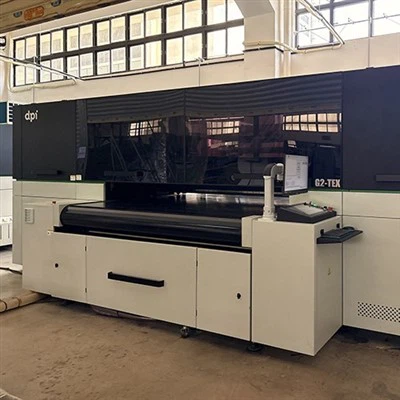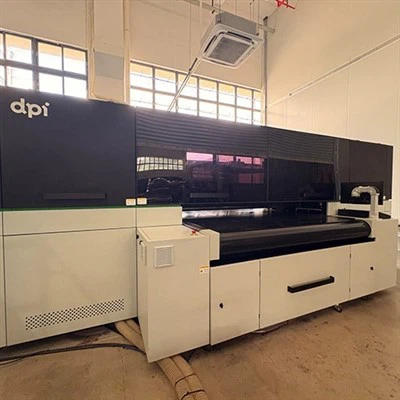


As a representative piece of modern digital printing equipment, the scanning digital inkjet printer integrates multiple key technologies, including precision mechanical engineering, digital image processing, and microfluidic control, forming an innovative architecture centered on "dynamic scanning + precise printing."This principle not only breaks through the physical width limitations of traditional printing but also endows the equipment with high flexibility and precision, becoming an important support for the evolution of industrial printing towards intelligence and customization.
From an overall structural perspective, the design of the scanning digital inkjet printer revolves around "line-by-line imaging." The equipment consists of a printhead carriage driven by high-precision guide rails, printhead modules for continuous or on-demand inkjet printing, a media transport platform, and a real-time image processing and motion control system. During operation, the printhead moves at a constant speed along the width of the media while receiving line-by-line data instructions from the image processing unit, ejecting ink droplets to the corresponding positions as needed, thereby forming complete patterns or text on the media. This dynamic scanning method allows the equipment to adapt to media of varying lengths and widths, freeing it from the width constraints of fixed-array printing.
At the printing mechanism level, its core lies in the synchronization of droplet control and positioning. Piezoelectric or thermal bubble elements inside the printhead precisely deform according to electrical signals, forming ink droplets with diameters of tens of micrometers or even smaller. These droplets are then guided towards the substrate surface by an electric field or airflow. During scanning, the motion control system calculates the correspondence between the printhead position and image data in real time. Using encoder feedback and closed-loop control algorithms, it ensures that the droplet landing position error remains within a minimal range, thus achieving high resolution and high registration accuracy. Some equipment also incorporates grayscale or variable droplet technology, adjusting droplet volume and ejection frequency to create richer image layers and more natural transitions.
The coordination between image processing and the control system is another key principle. The input design file, after color management, color separation, and path optimization, is decomposed into a data stream matching the printhead scanning step size, maintaining strict timing synchronization with the mechanical movement during the printing process. This synchronization relies not only on high-speed hardware transmission channels but also on software algorithms to smooth acceleration and speed changes, preventing printing distortion caused by mechanical inertia. Simultaneously, the ink supply system dynamically adjusts flow and pressure based on printhead status to ensure stable ejection and reduce the risk of ink interruptions and bleeding.
Overall, the design principle of scanning digital inkjet printers embodies the deep integration of multiple disciplines: controllable scanning through precision mechanics, precise ejection through microfluidic technology, and perfect synchronization of image and motion through digital control. This principle not only improves printing efficiency and quality but also provides a reliable technological foundation for industrial applications across multiple materials and scenarios, propelling the printing industry towards a higher level of digitalization and flexibility.