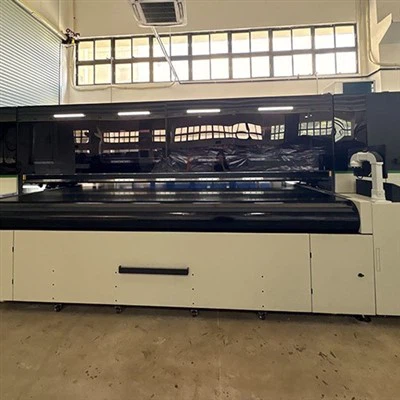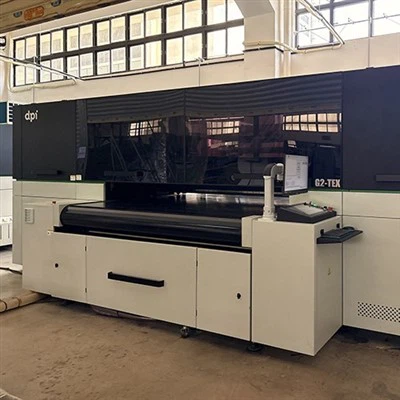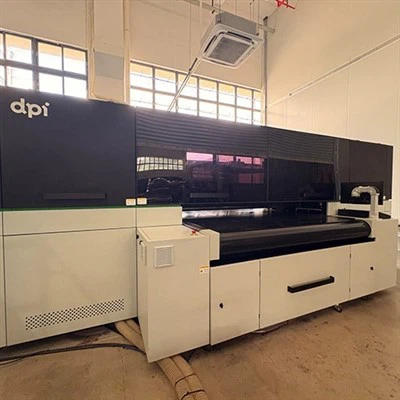


In the modern textile printing and dyeing industry, digital textile printing machines have become an important indicator of production technology level. Their performance directly affects printing quality, production efficiency, and the company's market competitiveness. In summary, the core performance of digital printing machines is reflected in printing accuracy, production speed, color consistency, material adaptability, and operational stability. These indicators collectively determine the equipment's practical value in diverse application scenarios.
Printing accuracy is a fundamental performance indicator of digital printing machines. High-end models are equipped with high-density printhead arrays, with a minimum ink droplet volume of up to picometers. Combined with high-resolution drive control, they can accurately present fine lines, rich layers, and smooth gradients on the fabric surface. Advanced color management and automatic calibration systems ensure that color deviations on different batches and fabrics are controlled within a minimal range, meeting the stringent requirements of visual consistency for high-end fashion and fine home textiles.
Production speed reflects the equipment's economy and capacity potential. The speed of a digital printing machine is limited by the number of printheads, scanning method, and data transmission efficiency. Modern equipment, through multi-head parallel operation and optimized fabric feeding and printing synchronization algorithms, can achieve high output while ensuring accuracy, especially in large-area full-page printing. For flexible production modes with multiple varieties and small batches, its rapid switchover and instant start-up capabilities further enhance overall production efficiency.
Color consistency and reproduction are key to measuring printing quality. The equipment's professional color management system accurately matches international standard color charts and maintains color stability under different fabric and ink combinations. Some models introduce closed-loop detection and automatic compensation mechanisms to monitor printhead status in real time and correct inkjet deviations, thus maintaining high-quality output during long-term operation.
Material adaptability reflects the equipment's versatility. High-quality digital printing machines can achieve good adhesion and color fastness on a variety of fabrics, including cotton, linen, silk, wool, synthetic fibers, and their blends. This is thanks to flexible printhead height adjustment, replaceable guide belts or flatbed platforms, and ink supply systems compatible with various ink systems. Parameter optimization for different fiber characteristics avoids problems such as bleeding, smudging, or fabric damage.
Operational stability is crucial for the reliability of continuous production. The equipment employs high-precision guide rails, servo drives, and a constant-temperature cooling system to reduce the impact of mechanical vibration and temperature fluctuations on printing quality. Intelligent fault monitoring and early warning functions can detect printhead blockages and ink path abnormalities in advance, minimizing downtime risks and ensuring smooth production line operation.
Overall, textile digital printing machines have formed a relatively complete performance system in terms of precision, speed, color, adaptability, and stability. With continuous advancements in printhead technology and software algorithms, their overall performance will continue to improve, providing the textile printing and dyeing industry with more efficient and higher-quality digital solutions.