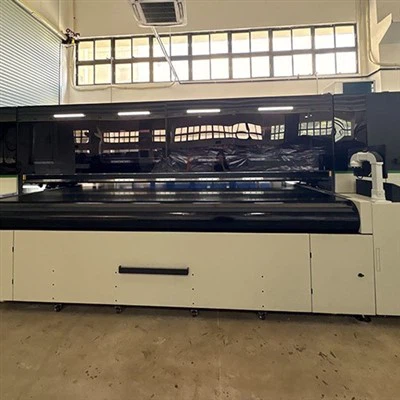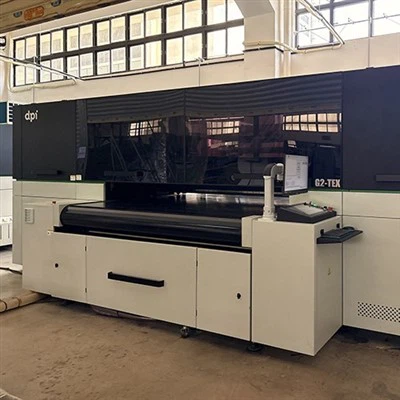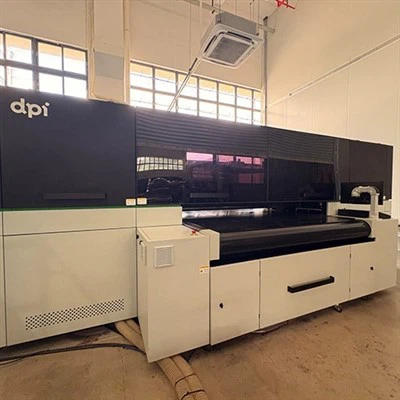


As a key piece of equipment in the digitalization of textile printing and dyeing, the performance of digital textile printing machines is closely related to their structural design.The entire machine consists of five core modules: the ink supply system, the printhead assembly, the motion control system, the printing platform, and the data processing unit. These modules work in close coordination to achieve high-precision, high-efficiency pattern output.
The ink supply system is the "color source" of printing, typically composed of a main ink cartridge, secondary ink cartridges, filters, and ink supply pipelines. The main ink cartridge stores inks of different colors, while the secondary ink cartridges monitor the remaining ink level in real time via a level sensor, working with a constant pressure device to maintain stable ink pressure and prevent inkjet abnormalities caused by pressure fluctuations. The filter intercepts tiny particles of impurities in the ink, protecting the printhead from clogging and ensuring uniform ink droplet shape.
The printhead assembly is the "heart" of the equipment, directly determining printing accuracy and speed. Currently, most mainstream models use piezoelectric or thermally atomized printheads, integrating hundreds to thousands of independent nozzles arranged in an array. During operation, the drive circuit generates pulse signals based on image data, causing the nozzles to eject picometer-sized ink droplets as needed. The smallest droplet diameter can reach several picometers, thus achieving the reproduction of fine lines and gradient colors. The printhead needs to be equipped with a constant temperature cooling system to maintain a stable operating temperature and prevent temperature changes from affecting ink viscosity and ejection accuracy.
The motion control system acts as the "nerve center," including servo motors, guide rails, synchronous belts, and encoders. It drives the printhead to move laterally along the X-axis while coordinating the printing platform to step longitudinally along the Y-axis. The two work together to achieve precise positioning in a plane. The application of high-resolution encoders can control the positioning error within ±0.1mm, ensuring consistent printing positions for repeated printing and meeting the registration requirements of mass production.
The printing platform is the "support base" for the fabric and needs to have good flatness and breathability. Some models employ a vacuum adsorption design, using a porous platform and negative pressure system to fix the fabric, avoiding wrinkles caused by uneven tension during printing and ensuring a constant distance between the printhead and the fabric. This is especially crucial for the printing quality of thin or elastic fabrics.
The data processing unit acts as the "intelligent brain," equipped with a high-performance processor and dedicated software. It receives, analyzes, and optimizes the printing pattern data, converting it into printhead-readable injection commands. It also coordinates the actions of each module in real time, achieving seamless integration of "data-mechanics-color."
This collaborative optimization of all structures enables the textile digital printing machine to combine high precision, high speed, and strong adaptability, providing the industry with a reliable digital printing solution.